

How to Make Monogrammed Bed Sheets Last for Years
Last Updated: October 26, 2026
Quick Summary
Monogrammed bed sheets last for years when you buy long-staple cotton with a 300 to 600 thread count and dense, well-anchored embroidery, then wash them cold on a gentle cycle in a mesh bag and dry on low heat. Rotating two or three sets spreads friction and extends their life.
- Long-staple cotton creates stronger yarn that resists pilling and thinning.
- A 300 to 600 thread count balances softness with durability.
- Quality cotton sheets typically last one to three years with daily use.
- Turn embroidered pieces inside out and wash them in a fine-mesh bag.
- Skip chlorine bleach, fabric softener, and dryer sheets entirely.
Table of Contents
- What Decides Whether Monogrammed Bed Sheets Last
- The Best Fabric for Durable Bed Sheets
- How Long Do Bed Sheets Last?
- How Embroidery and Monogram Placement Affect Durability
- How to Wash Embroidered Sheets Without Damaging Them
- Care Instructions for Monogrammed Linens: A Simple Routine
- Signs Your Sheets Need Replacing or Repairing
- Choosing Monogrammed Bed Sheets Built to Last
- Frequently Asked Questions
What Decides Whether Monogrammed Bed Sheets Last
Most people assume a high price tag guarantees long life. It doesn't. The durability of monogrammed bed sheets comes down to three things: fiber quality, weave density, and stitch construction.
At Embroidery Studio Plus, we've learned that longevity is built in, not promised on a label. Below, we'll show you exactly what separates a set that endures from one that fails, plus a care routine that protects both fabric and stitching.
Fiber, Weave, and Stitch Quality
Fiber strength sets the ceiling on how long any sheet will last. Long-staple cotton produces longer individual fibers, which means fewer exposed ends and less pilling over time. A tight, even weave adds resistance to wear.
Watch out: a bargain monogram often uses short-staple cotton and sparse stitching. It looks fine on day one and shows wear fast.
The Best Fabric for Durable Bed Sheets
Long-staple cotton, including Egyptian and Pima varieties, is the best fabric for durable bed sheets. Its longer fibers create a stronger yarn that resists pilling and thinning.
Thread count matters, but only within reason. A range of 300 to 600 thread count balances softness with durability.
If you want to see this fabric guidance in practice, browse our 600 thread count monogrammed bed sheets to compare weave and finish.

How Long Do Bed Sheets Last?
Quality cotton sheets typically last one to three years with daily use, and longer when rotated between sets. Monogrammed bed sheets sit at the higher end when the fabric and stitching are sound. The variables that shorten life are constant friction, harsh detergent, and high heat.
- Daily use on one set: faster wear at the feet and hips
- Rotating two or three sets: spreads the friction
- Hot water and high dryer heat: breaks down fibers early
For a fuller breakdown of whether a higher price pays off over that lifespan, read is luxury bedding worth it.
How Embroidery and Monogram Placement Affect Durability
A monogram is a structural addition to the sheet, not a decorative afterthought. Every stitch punches through the weave and anchors thread to fabric, so the way that embroidery is built determines whether the sheet wears at the initials or holds up for years. Four variables matter most: stitch density, backing and stabilizer, thread choice, and placement.
Stitch density and fabric stress
Dense satin-stitch monograms, the solid, raised letterforms common on luxury linens, put more needle holes per square inch into the fabric than lighter fill stitches. That density looks crisp, but it also stiffens the surrounding weave and concentrates stress along the perimeter of the design. When the sheet flexes in the wash, the fabric at the edge of a dense monogram takes the load.
Backing and stabilizer
Embroidery needs something behind it to keep stitches from pulling through the weave. A cut-away or tear-away stabilizer supports the design during stitching and, in better construction, remains as a soft backing that distributes stress. Monograms stitched with no backing, common on inexpensive imported sets, are more likely to pucker, distort, or develop holes at the stitch line after repeated laundering.
Thread choice
Embroidery thread is usually rayon, polyester, or cotton. Rayon has high sheen but lower abrasion resistance and can fuzz or break with friction. Polyester thread is the most abrasion-resistant and colorfast, which is why it holds up best through repeated washing. Cotton thread blends visually with cotton sheeting but can shrink at a different rate than the ground fabric, causing puckering.
Placement and friction zones
Where the monogram sits changes how much mechanical stress it absorbs. On a flat sheet, initials near the center or upper third sit away from the feet and hips, the highest-friction zones. On pillowcases, embroidery along the open edge or a few inches in from the hem avoids the face-contact and rubbing area. A large, tight design placed at the foot of the sheet, where heels and toes grind nightly, will abrade faster than the same design placed higher.
How to assess monogram quality before buying
- Stitch consistency: rows should be tight and even, with no gaps, skipped stitches, or loose loops.
- Thread tension: the fabric around the design should lie flat, not puckered or drawn in.
- Backing: a soft stabilizer behind the design signals better construction than bare fabric.
- Thread feel: smooth and tightly twisted, not fuzzy or hairy.
- Placement: on sheets you'll sleep on, initials should sit away from feet and hips.
- Finishing: trim any visible jump threads or knots; loose tails are the first thing to snag.
A monogram that passes these checks is built to survive laundering. One that fails them may look fine in the package and show wear within a few wash cycles.
If you want to compare trim and embroidery construction, our monogrammed sheets with eyelet lace trim show how decorative trim sits alongside custom stitching.

How to Wash Embroidered Sheets Without Damaging Them
Embroidered sheets fail in the wash for reasons plain sheets don't: thread abrades against other fabrics, stabilizer breaks down under heat and agitation, and loose stitch tails snag on zippers, buttons, and towel loops. A wash routine built for the embroidery, not just the cotton, is what keeps a monogram intact.
Luxury Monogrammed Egyptian Cotton Bed Sheet Set -600 Thread Count with Custom →
Sort and prep
Turn monogrammed pieces inside out so the embroidery faces the drum wall rather than rubbing against other items. Place each embroidered piece in a mesh laundry bag; a fine-mesh bag rated for delicates is best because it contains loose threads and shields raised stitching from friction. Keep embroidered linens away from towels, jeans, and anything with zippers, hooks, or buttons, those are the items most likely to snag a stitch.
Water temperature and cycle
Cold water on a gentle or delicate cycle is the default. Heat is the enemy of both cotton and embroidery thread: hot water accelerates fiber breakdown and can shrink cotton thread at a different rate than the ground fabric, which causes puckering around the design. Agitation is the second enemy, a normal cycle's tumble is enough to abrade raised stitching over time, so use the shortest gentle cycle that gets the job done.
Detergent and additives
Use a mild, liquid detergent and measure to the low end of the recommended dose; residue left in the fabric attracts soil and stiffens thread. Skip chlorine bleach entirely, it weakens both cotton and embroidery thread and can yellow white monograms over time. Skip fabric softener and dryer sheets as well: softener coats fibers and thread with a waxy film that reduces absorbency and can dull embroidery sheen, and dryer sheets add a coating that builds up with every cycle.
Drying
Tumble dry on low or line dry. High heat is the most common cause of embroidery puckering and cotton shrinkage, so keep the dryer on the lowest setting and remove the sheets while slightly damp. Line drying in shade protects both fabric color and thread sheen. Avoid hanging a wet monogrammed sheet by the embroidered edge, the weight of wet cotton can distort the stitching.
Ironing around stitching
Press from the reverse side, with a pressing cloth between the iron and the embroidery if you must press the face.
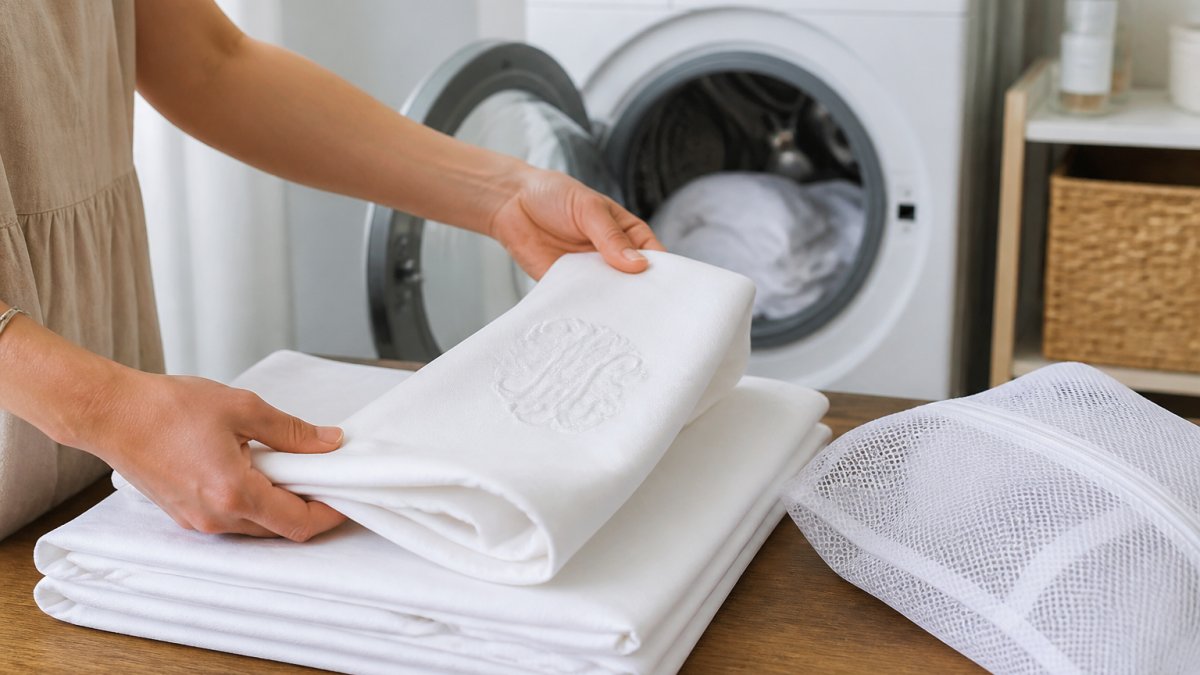
A wash-cycle checklist
- Cold water, gentle cycle, shortest practical duration
- Mild liquid detergent, low dose
- No chlorine bleach, no fabric softener, no dryer sheets
- Mesh bag for every embroidered piece
- Separate from towels, jeans, and anything with zippers or hooks
- Low-heat tumble dry or line dry; remove slightly damp
- Iron from the reverse side only
Repairing a snag before it spreads
If a thread pulls during washing, do not cut it at the base or pull it tight, either can rip the surrounding weave.
A common mistake is washing embroidered linens with heavy items like towels or jeans. The friction roughens the embroidery and causes snags. Wash them alone or with other light linens.
Follow this checklist each time you launder embroidered sheets to protect both the cotton and the stitching.
| Step | What to do |
|---|---|
| Water temperature | Cold water on a gentle or delicate cycle |
| Detergent | Mild liquid detergent, measured to the low end |
| Bleach and softener | Skip chlorine bleach, fabric softener, and dryer sheets |
| Sorting | Turn inside out, use a mesh bag, separate from towels and jeans |
| Drying | Tumble dry on low or line dry; remove slightly damp |
| Ironing | Press from the reverse side only, never directly on stitching |
| Snags | Work the snag to the reverse side and tack it in place |
Care Instructions for Monogrammed Linens: A Simple Routine
A steady routine beats occasional deep cleaning. Follow these care instructions for monogrammed linens and both fabric and thread stay intact:
- Wash after every one to two uses in cold water
- Use mild detergent and skip softener
- Dry on low heat or air dry
- Rotate between at least two sets
- Store folded in a dry, breathable space
For a deeper complete guide to maintaining embroidered pieces, read how to maintain embroidered linens.
Signs Your Sheets Need Replacing or Repairing
Thin patches, small holes, and frayed edges signal that fibers are giving out. Fading and shrinkage point to heat and harsh detergent over time. Snags and loose embroidery threads are often repairable if you act early.
- Repair: a loose thread or single snag, caught before it spreads
- Replace: thin spots, multiple holes, or fraying along seams
- Watch out: pulling a snag tight can rip the surrounding weave, so trim it carefully instead
Choosing Monogrammed Bed Sheets Built to Last
Buy for fiber and stitch, not just appearance. Look for long-staple cotton, a sensible thread count, and dense, well-anchored embroidery. Those three factors decide how many years you get.
Our luxury monogrammed Egyptian cotton bed sheet set pairs a 600 thread count sateen weave with custom embroidery and a scalloped border, built for the long haul.

Frequently Asked Questions
Does embroidery make bed sheets less durable?
Embroidery itself does not shorten a sheet's life, but heavy stitching on thin fabric can. Dense monograms pull at the weave and create small stress points that fray first. On a 600 thread count cotton sheet, embroidery sits on a strong surface and holds up well. Placement matters too: a monogram near the hem or pillowcase edge takes less friction than one in the middle of the sleeping area.
Can embroidered bed sheets go in the dryer?
Yes, on low heat. High heat is what damages embroidery thread, causing it to shrink, fade, or pucker against the fabric. Use a low tumble setting and remove the sheets while slightly damp, then smooth and fold them. Skip dryer sheets, since the coating can dull embroidery thread over time. Air drying flat or on a line is the gentlest option for monogrammed bed sheets.
How should you wash monogrammed bed sheets?
Turn them inside out, use cold or lukewarm water on a gentle cycle, and choose a mild detergent without bleach or fabric softener. Wash monogrammed bed sheets separately from towels and anything with zippers or hooks that can snag stitching. A mesh laundry bag adds protection for the embroidered areas. Follow the care instructions for monogrammed linens included with your set for the best results.
How long do bed sheets last with regular washing?
Quality cotton sheets typically last two to three years with weekly washing, and longer with rotation between sets. Long-staple cotton and a tight weave resist pilling and thinning better than short-staple fabric. Monogrammed bed sheets from a quality maker often outlast plain sets because the base fabric is chosen for durability. Watch for thinning spots, small holes, and fraying edges as signs it is time to replace.
Durability isn't luck. It's the right fiber, the right stitch, and the right care. Embroidery Studio Plus handcrafts custom monogrammed linens from premium 600 thread count cotton, with personalized embroidery and finishes made to last. Explore our ready-made and custom pieces, and subscribe to our emails for care tips and new arrivals.
